 Wakanai
You already learned one language this way.
Before anyone showed you a flashcard, you learned your first language by hearing a lot of it when the meaning was obvious. Someone pointed at the dog and said "dog." Linguists call this comprehensible input: language you mostly understand from context, delivered slightly above your level. Decades of second-language research point to it as the engine of acquisition; everything else supports it.
The problem for adults learning Japanese is that almost nothing is comprehensible on day one, so apps retreat to what's easy to gamify: tapping tiles, matching pairs, streaks that punish you for having a life. You get good at the app. Japan, unfortunately, tests listening and speaking.
Wakanai makes real Japanese comprehensible from day one, then asks you to prove it out loud.
Pictures first, because translation is a crutch
Every session is one real podcast episode: unscripted Japanese at a learner-friendly speed. On the first pass there is no text at all. Watercolor scenes switch in time with the story and carry the meaning, the way the pointed-at dog carried "dog." Your brain connects sound to situation instead of translating through English and hoping.
Reading along on a first listen feels productive, but it quietly replaces listening with reading. You can't do that in a conversation. So the first pass takes the text away.
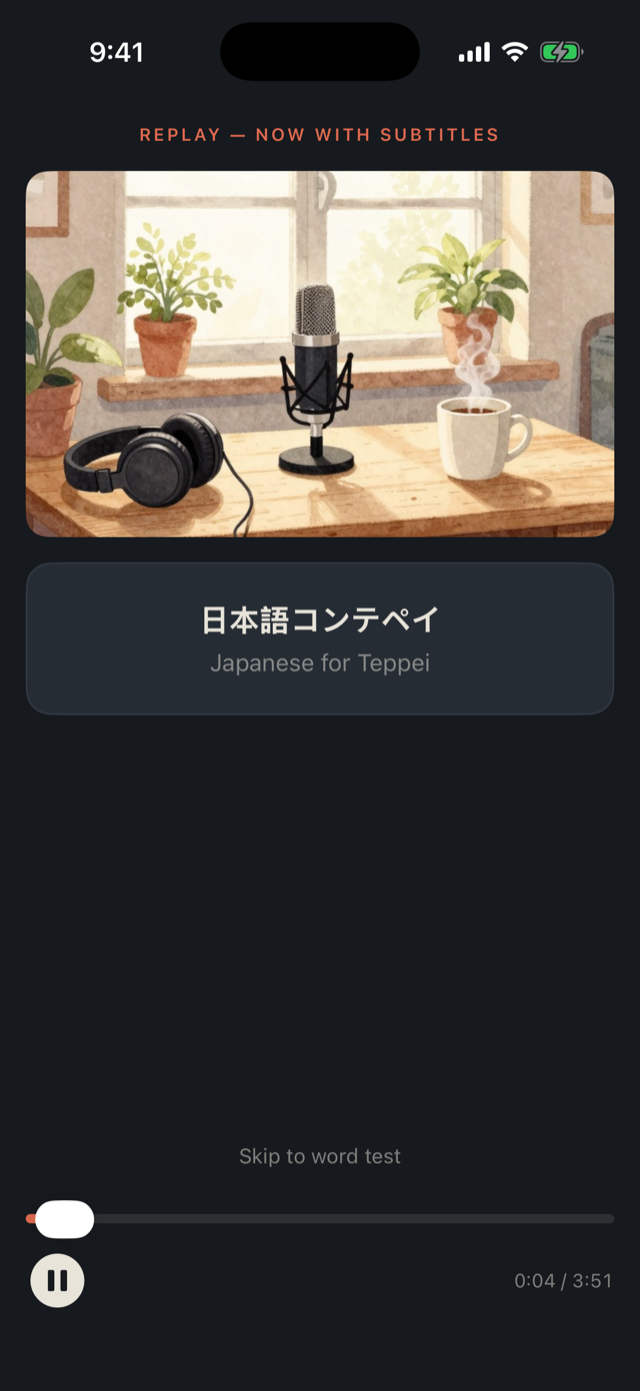
Then the replay, so you know what you caught
The second pass replays the same episode with Japanese and English line by line, and the session's core words light up as they're spoken. This is where guesses get confirmed or corrected. You already built the meaning from context; now the text anchors it. Hearing the same input twice matters because the second listen is much easier to follow than the first.
Your voice is the test, because self-grading lies
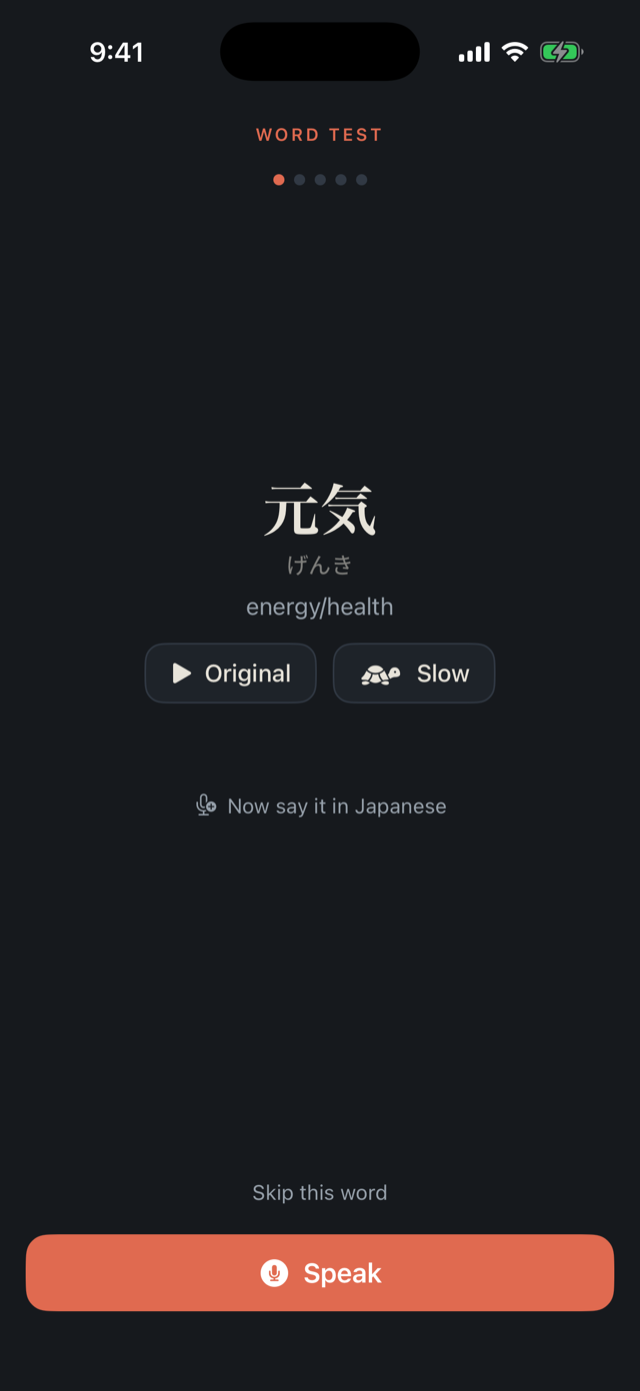
Flashcard apps ask, "did you know it?" and let you answer yes. Recognition feels like knowledge; it isn't. Wakanai ends every session by playing each new word in a clear studio voice and asking you to say it back. Later reviews flip direction: hear the Japanese, speak the meaning in English. On-device speech recognition grades both. No pity passes, no benefit of the doubt, and no recording ever leaving your iPhone.
The recognizer is a judge, not a tyrant. If it mishears you, you can override it. But the default is honesty, and honest recall under mild pressure is what a train announcement gives you.
Spacing that argues with your forgetting curve
Every word you learn is scheduled with FSRS, a modern spaced-repetition algorithm that models your forgetting curve and brings each word back just before you'd lose it. The default is five new words a day, with three or ten available in settings and an encore episode when you want one more. Every word comes from an episode you actually understood, then gets defended out loud over the following weeks. It compounds quietly.
Kanji without the wall
Kanji are built from smaller pieces, so Wakanai teaches the pieces first: you learn 王 and 水 so that 電球 ("light bulb") can arrive later. It stays out of your queue until the parts of 球 are already yours. You never face a twenty-stroke wall of a word with no handholds; hard words wait until they're easy.
A lantern, not a leash
Practice lights a paper lantern; a row of them collects on your home screen, and Toro walks over to admire it. Miss a day and the lantern flickers instead of dying. One short session relights it. There's no currency to lose, nothing to buy back, and a lantern that does go out simply starts again at one. Your session stats are facts: minutes of Japanese heard, seconds spoken aloud, never points.
What this adds up to
Real Japanese first, supported by pictures. Then subtitles. Then speech, on a schedule that follows your memory. Kanji and vocabulary arrive in an order your brain can actually climb. No gems, no leagues, and no guilt after 9pm.